
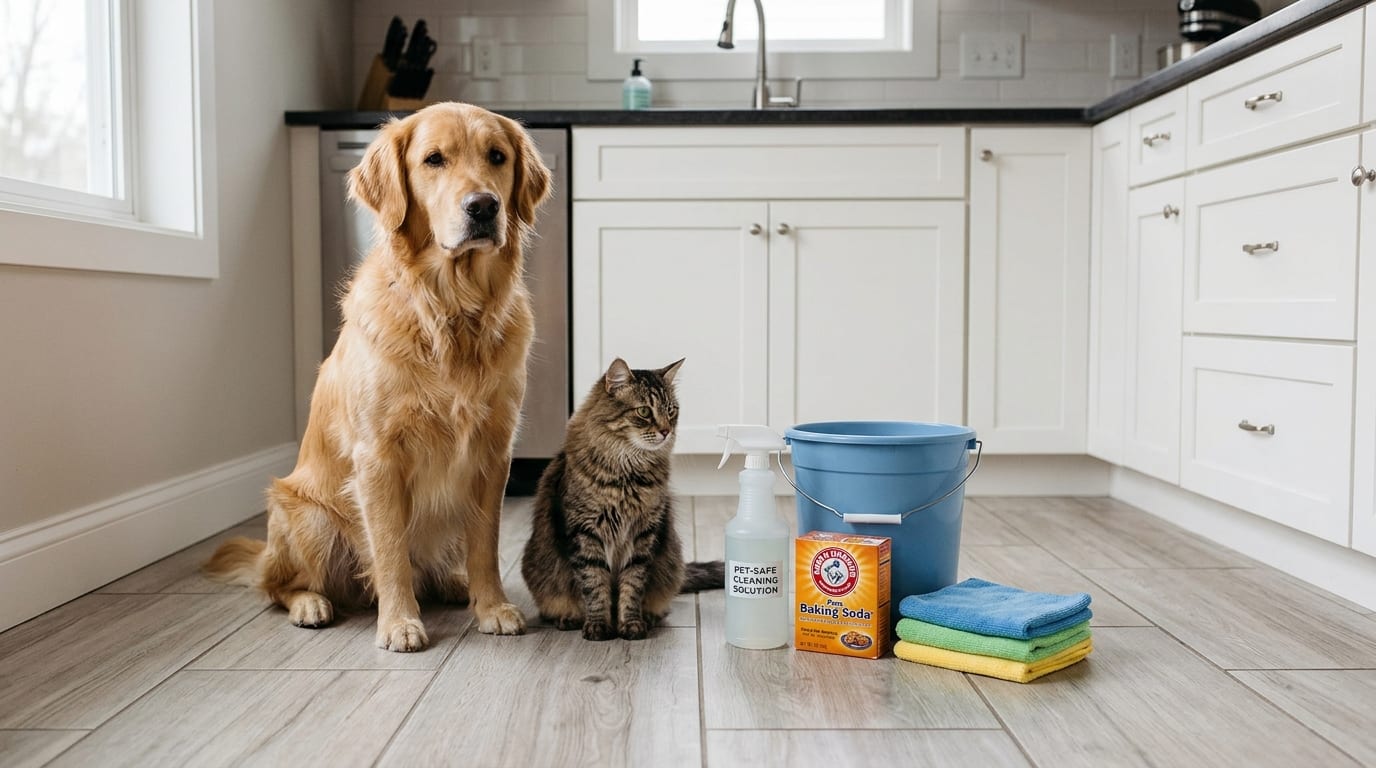
Most of what a pet household needs to stay clean costs under $140 a year, and the starter kit itself runs less than $60. The expensive part is not the cleaning. It is the emergency vet visit that follows a cat walking across a floor mopped with the wrong disinfectant, or the carpet replacement that happens after six months of urine soaking into the pad because vinegar never actually broke down the stain.
This guide covers what to buy, what each item costs per use, which ingredients carry documented toxicity risk for dogs and cats, and what pet odor removal really runs when DIY is no longer enough.
PetPremium is a licensed pet insurance comparison broker (NPN #17028173) operating in all 50 U.S. states. Having previously operated as an active pet insurance provider, PetPremium brings first-hand underwriting knowledge to help pet owners compare coverage, with an insider's understanding of what policies actually deliver when it counts.
What "pet-safe" actually means on a label
There is no federal standard for the phrase "pet-safe." The FTC's Green Guides address unqualified "non-toxic" claims as potentially deceptive, but enforcement is rare and the phrase "pet-safe" is essentially unregulated marketing language. A bottle can say pet-safe and still contain quaternary ammonium compounds.
Two label signals carry more weight than the words on the front:
- EPA Safer Choice certification. The Safer Choice program screens every ingredient in a formula against health and environmental criteria. It is not a pet-specific certification, but certified products exclude most of the ingredient classes that cause pet poisoning calls.
- A full ingredient list. Cleaning products are not required to disclose all ingredients. A brand that publishes the complete list is giving you something you can actually check.
"Natural" and "plant-based" mean nothing here. Tea tree oil is plant-based and is one of the more common essential oil toxicity cases in cats.
Ingredients worth avoiding
| Ingredient | Commonly found in | Why it matters |
|---|---|---|
| Phenols / phenolic compounds | Pine-scented cleaners, some disinfectant sprays | Cats metabolize phenols poorly due to limited glucuronidation capacity; linked to liver damage and oral ulceration |
| Quaternary ammonium compounds (benzalkonium chloride) | Disinfecting wipes and sprays, "kills 99.9%" products | A documented cause of tongue and mouth ulcers in cats that walk on wet treated surfaces and groom their paws |
| Ammonia | Glass cleaners, some floor cleaners | Respiratory irritant; also smells like urine to a dog or cat, which can trigger re-marking of the exact spot you cleaned |
| Sodium hypochlorite (bleach) | Household bleach | Useful when diluted and rinsed, dangerous concentrated; never mix with ammonia or acids |
| Essential oils (tea tree, pennyroyal, wintergreen, pine, citrus, eucalyptus) | "Natural" cleaners, diffusers, DIY recipes | Concentrated oils are absorbed through skin and ingested during grooming; cats are particularly vulnerable |
| 2-butoxyethanol and other glycol ethers | Degreasers, all-purpose sprays | Irritant; higher-dose exposure associated with hemolysis |
| Isopropyl alcohol | Disinfectant sprays, hand sanitizer | Rapid absorption through skin and GI tract; small volumes matter for small animals |
| Cationic detergents | Fabric softener, dryer sheets | Corrosive injury risk if chewed |
The ASPCA Animal Poison Control Center and the Pet Poison Helpline both publish case-based guidance on these categories and are worth bookmarking before you need them.
The budget toolkit: six items, under $60
| Item | Typical price | Cost per use | What it handles |
|---|---|---|---|
| Enzymatic cleaner, 1 gal or concentrate | $20-$30 | $0.30-$0.80 per treated spot | Urine, vomit, anal gland odor, anything organic |
| Distilled white vinegar, 1 gal | $4-$6 | ~$0.10 per spray bottle | Hard floors, glass, soap scum, litter box film |
| Baking soda, 12-13 lb bag | $8-$10 | ~$0.15 per carpet treatment | Odor absorption, mild abrasive, litter box deodorizing |
| 3% hydrogen peroxide, 32 oz | $1.50-$3 | ~$0.20 per stain | Blood and protein stains (spot-test fabrics first) |
| Unscented liquid dish soap | $4-$6 | pennies | Paws, bowls, bedding pre-treatment, grease |
| Microfiber cloths, 24-pack | $12-$18 | reusable | Everything else, replaces paper towels |
Add a $3-$6 bottle of household bleach and a measuring cup only if you have a specific infectious disease situation (more on that below).
That is the entire kit. A two-pet household typically spends $70-$140 per year on replenishment, with enzymatic cleaner accounting for most of it.
Where DIY recipes fail
Vinegar and baking soda are good at what they do and useless at the thing most pet owners buy them for. Cat and dog urine contains uric acid, which forms crystals that are not water-soluble and are not neutralized by acids. Vinegar temporarily masks the smell. Then humidity rises, the crystals re-activate, and the odor returns in July.
Enzymatic cleaners work differently: they contain bacterial cultures that produce enzymes which digest the uric acid, proteins and fats directly. This is the one category where the cheap substitute genuinely does not work, and where buying a concentrate instead of a ready-to-use spray cuts cost by roughly 60 to 75 percent.
Two rules for using them: saturate the area as thoroughly as the original accident did (enzymes have to reach the same depth as the urine), and let it air-dry rather than blotting it off. Enzymes need hours of contact time.
Pet odor removal cost: what each escalation step runs
| Approach | Typical cost | When it makes sense |
|---|---|---|
| Enzymatic treatment, DIY | $0.30-$2 per spot | Fresh or recent accidents on carpet, upholstery, hard floors |
| Portable spot cleaner (purchase) | $100-$150 one-time | Three or more accidents a month; pays for itself in about two rentals |
| Carpet cleaner rental | $35-$55 per day plus $20-$30 solution | Whole-room refresh once or twice a year |
| Professional carpet cleaning | $130-$350 per visit, or roughly $0.25-$0.60 per sq ft | Set-in odor across multiple rooms |
| Professional pet odor remediation (enzyme injection, ozone or hydroxyl) | $200-$800 | Urine that has reached the pad |
| Subfloor sealing (shellac-based primer, DIY) | $35-$50 per gallon, covers ~300 sq ft | Urine soaked into plywood or concrete |
| Carpet and pad replacement | $3-$7 per sq ft installed | Multiple saturation events in the same area |
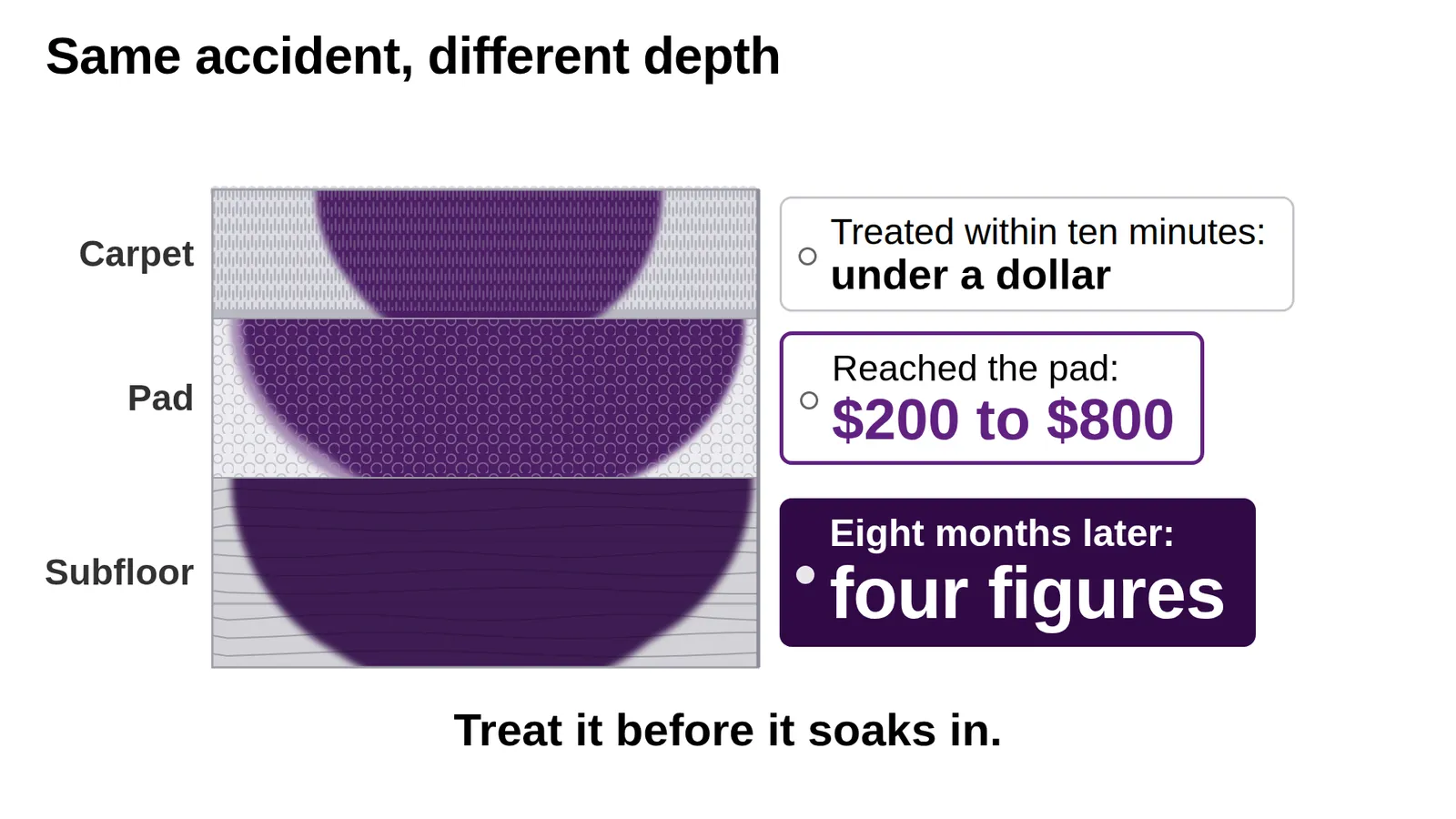
Prices vary significantly by region and by home size; figures here reflect commonly quoted national ranges from home services marketplaces. The pattern worth noticing is the jump from the top of the table to the bottom. Treating an accident within ten minutes costs under a dollar. Treating the same accident eight months later, after it has soaked through carpet into pad and subfloor, can cost four figures.
Cleaning versus disinfecting
These are separate jobs and most households only need the first one.
Cleaning removes organic matter and odor. Enzymatic cleaner, dish soap, vinegar and microfiber handle it.
Disinfecting kills pathogens. You need it in specific situations: a parvovirus or panleukopenia case in the home, ringworm, a giardia outbreak, a new foster animal of unknown health status, or a multi-pet household with recurring GI illness.
Canine parvovirus is the clearest example of why the distinction matters. It is non-enveloped and resistant to most common disinfectants, and it can persist in the environment for months. Neither vinegar nor standard enzymatic cleaner inactivates it. Veterinary guidance, including from Cornell University's College of Veterinary Medicine, points to diluted bleach as the accessible option: roughly half a cup of household bleach per gallon of water (about a 1:32 dilution), applied to a pre-cleaned surface, left wet for at least ten minutes, then rinsed and fully dried before any animal returns to the area.
Contact time is the step most people skip. Spraying and immediately wiping disinfects almost nothing.
Mess-by-mess, cheaply
Fresh urine on carpet. Blot with a towel and body weight, do not rub. Saturate with enzymatic cleaner to the depth of the original accident. Cover with a towel, leave 12 to 24 hours, air-dry. Skip the steam cleaner on urine; heat can set the proteins.
Vomit or bile. Scrape solids with a stiff card, treat residue with enzymatic cleaner, finish with baking soda once dry to pull remaining odor. Yellow bile stains on light carpet respond to 3% hydrogen peroxide, but spot-test an inconspicuous area first.
Diarrhea on hard floors. Remove solids, wash with dish soap and warm water, then rinse. Only reach for diluted bleach if there is a known infectious cause.
Litter boxes. Hot water, unscented dish soap, a dedicated brush. Vinegar soak once a month for mineral and ammonia buildup. Avoid scented or disinfectant-based cleaners here; residual odor is a documented reason cats stop using a box, and an avoidance problem is more expensive than the cleaner.
Beds and fabrics. Pre-soak in enzymatic cleaner, wash hot with unscented detergent, half a cup of baking soda in the drum, no fabric softener or dryer sheets. A $15 washable cover on a $90 bed is the cheapest insurance in this article.
Paws and coats. Plain warm water and a microfiber cloth by the door handles most of it. Reserve shampoo for actual dirt, since over-washing drives skin issues that end in a vet visit.
From the claims side: what toxin exposure looks like in the data
Household toxin claims have a distinctive shape. They arrive the same day as the incident, almost always through an emergency clinic rather than a primary vet, and they are concentrated in a few categories: human medications, chocolate and xylitol, rodenticide, and household chemicals. Cleaning product exposure is not the largest bucket, but it is among the most preventable, and it clusters in two patterns.
The first is cats and freshly mopped floors. A disinfectant containing quaternary ammonium compounds is applied, the cat crosses the wet surface, grooms, and presents hours later with drooling, oral ulceration and refusal to eat. The workup is typically an exam, oral assessment, sometimes sedation, pain control and supportive care. Claim totals in this pattern commonly land in the $300 to $1,200 range.
The second is dogs and chewed containers. A bottle of concentrated cleaner or a container of dishwasher pods gets punctured. These cases escalate faster because of caustic injury risk and often involve induced emesis (contraindicated for corrosives, which is why calling first matters), bloodwork, IV fluids and 24 to 48 hours of hospitalization. Totals of $1,500 to $4,000 are not unusual, and esophageal injury cases can exceed that.
Three coverage mechanics are worth understanding before you need them:
Timing is the common denial trigger, not the cause. Toxin ingestion is an accident, and accident waiting periods are short across the market, typically somewhere between one day and 14 days depending on the carrier. A poisoning that happens inside that window is a legitimate denial under the policy terms even though nothing about the event is suspicious. New pet owners are disproportionately affected because puppies and kittens arrive in homes with cleaning supplies at floor level.
"Negligence" exclusions are rarer than owners fear. Pet owners who call after a toxicity incident frequently assume the claim will be denied because the exposure was preventable. In practice, standard accident and illness policies do not exclude accidents on the grounds that the owner could have avoided them. The real exclusions that bite are waiting periods, annual limits already exhausted, and pre-existing conditions unrelated to the incident.
Repeat incidents get re-examined. A single toxicity event is straightforward. A second one in the same policy year sometimes triggers a closer review of the medical record, which is where unrelated pre-existing condition findings occasionally surface.
If exposure happens
Get the container. Note the time and the estimated amount. Call a vet or a poison control line before inducing vomiting, because the wrong move with a corrosive or petroleum-based product causes more damage on the way back up than it did going down.
Both national lines charge a consultation fee, currently around $85 to $95, and that fee buys a case number your emergency vet can use to coordinate treatment. It is money well spent. Rinse skin or eye exposure with lukewarm water for 15 to 20 minutes while you call.
Many policies reimburse the poison control consultation fee as part of the claim. Many do not. It is a small line item, but it is a useful tell: a plan that covers it tends to have a broader definition of covered treatment costs overall.
If you are trying to figure out whether your current coverage would actually pay for an emergency toxicity visit, or what accident waiting periods look like across carriers, comparing plan terms side-by-side takes a few minutes.
Compare Accident Coverage Across Carriers
The practical takeaway
Buy the enzymatic cleaner. Make the vinegar, baking soda and microfiber do everything else. Read the back of any product labeled pet-safe, and keep anything concentrated behind a latched door rather than under a sink with a magnetic catch a determined Labrador can defeat.
The annual cost of doing this properly is somewhere under $140 for most households. The cost of one preventable emergency visit starts at roughly double that and has no realistic ceiling.